
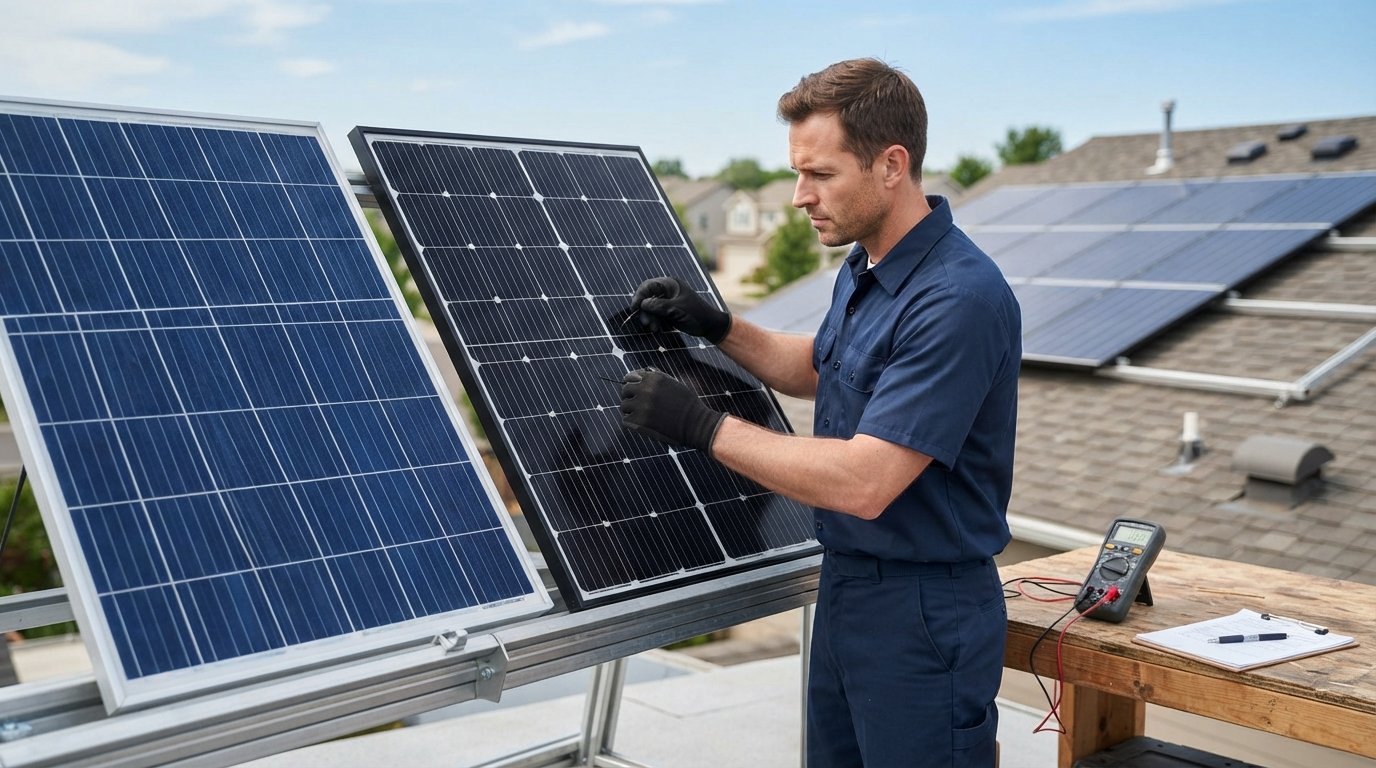
TOPCon vs HJT Solar Panels: Best Choice for Home Installation
Compare TOPCon vs HJT solar panels for home installation, including efficiency, cost, and ideal use cases. Call (833)-212-3715 for expert guidance.

By Caleb Hayes
Learn more about Solar Panel Installation and Repair for guides, costs, and what to expect.
Compare Solar Panel Installation and Repair Pros Near You

Enter your ZIP code to compare independent local professionals and request free quotes.
When you start shopping for high-efficiency solar panels in 2026, two acronyms dominate the conversation: TOPCon and HJT. Both are next-generation cell architectures that promise more power per square foot, better performance in heat, and slower degradation than the conventional panels that filled roofs a decade ago. But they get there through very different manufacturing routes, and those differences translate into real trade-offs for homeowners. Choosing between TOPCon vs HJT solar panels for home installation is not about picking the absolute best laboratory champion. It is about matching a cell technology to your roof, your climate, your inverter, and your budget.
This guide breaks down how each technology works in plain language, compares the numbers that actually matter, and explains which homeowners benefit most from each. Along the way, you will see where a standard panel might still be the smarter financial move, and how to sanity-check your home's readiness before you commit. If you have not yet assessed your household's baseline electricity use, our guide on a home energy audit before installing solar panels is a smart first step, because the best panel technology cannot fix an oversized or poorly planned system.
What TOPCon and HJT Actually Mean in Plain Language
Every solar cell converts sunlight into electricity by separating electrons and holes inside a silicon wafer. The difference between cell types comes down to how the electrical contacts are built and how the surfaces are treated. TOPCon stands for Tunnel Oxide Passivated Contact. It is essentially an evolution of the standard PERC cell that has dominated the market for years. Manufacturers add an ultra-thin tunnel oxide layer and a doped polysilicon layer on the back side of the cell. That structure lets electrons tunnel through while blocking the recombination of charge carriers, which is the main way cells lose energy. In practical terms, TOPCon squeezes more voltage out of the same silicon and reduces electrical losses at the contacts.
HJT stands for Heterojunction Technology. Instead of relying on doped silicon layers alone, HJT sandwiches a crystalline silicon wafer between ultra-thin layers of amorphous silicon. This heterojunction, meaning a junction between two different forms of silicon, creates excellent surface passivation and a very high open-circuit voltage. HJT cells are often described as having a built-in tandem structure because the amorphous layers form their own junctions. The result is a cell that performs exceptionally well in high temperatures and can be made very thin. The trade-off is a more complex manufacturing process that requires specialized equipment and low-temperature steps.
The architectural difference matters for homeowners because it shapes everything downstream: how much power a module produces, how it behaves on a hot afternoon, how quickly it degrades, and what it costs. Neither technology is a gimmick. Both are commercially mature in 2026, with major manufacturers shipping modules to U.S. distributors. But they are not interchangeable, and the right choice depends on your specific installation.
How Each Technology Converts Sunlight and Where It Wins
TOPCon's strength is that it builds on the enormous manufacturing base of PERC. Most TOPCon production lines are upgraded PERC lines, which keeps costs lower and supply chains more predictable. The tunnel oxide and polysilicon layers improve passivation on the rear side, boosting efficiency into the 23 to 24 percent range for commercial modules. Because the process is an evolution rather than a reinvention, TOPCon modules are widely available from tier-one manufacturers and are often priced only slightly above premium PERC panels. For a homeowner, that means a familiar product with better performance and a shorter learning curve for installers.
HJT takes a different path. The amorphous silicon layers provide superior passivation on both sides of the wafer, which pushes cell efficiencies higher, often into the 24 to 25 percent range for commercial modules, with some premium products exceeding that. HJT also has a naturally lower temperature coefficient, meaning it loses less output as the panel heats up. On a 95-degree Fahrenheit roof in Arizona or Texas, that advantage is not theoretical. It shows up in daily production during the hottest months. HJT modules also tend to degrade more slowly in the field, which matters for a 25- to 30-year investment.
The catch is cost and complexity. HJT requires低温 processing and specialized equipment, and the supply chain for the conductive pastes and target materials is less mature than TOPCon's. That has historically kept HJT prices higher. In 2026, the gap has narrowed, but HJT still carries a premium in most U.S. markets. The question is whether your installation will capture enough value from that premium to justify it.
Efficiency, Temperature Coefficient, and Degradation Compared
When homeowners compare TOPCon vs HJT solar panels for home installation, three performance metrics do most of the work: efficiency, temperature coefficient, and degradation rate. Efficiency tells you how much power you get per square foot. Temperature coefficient tells you how much output drops as the panel heats up. Degradation rate tells you how much performance fades each year. Here is how the two technologies stack up on those measures in typical commercial products.
- Module efficiency: TOPCon modules generally range from 21.5 to 23.5 percent, while HJT modules range from 22.5 to 24.5 percent, with premium HJT products reaching higher.
- Temperature coefficient: TOPCon is typically around -0.30 to -0.35 percent per degree Celsius, while HJT is often -0.24 to -0.28 percent per degree Celsius.
- First-year degradation: TOPCon typically loses about 1 percent in year one, while HJT often loses about 0.5 percent or less.
- Annual degradation: TOPCon typically degrades 0.4 to 0.5 percent per year, while HJT typically degrades 0.25 to 0.35 percent per year.
Those numbers look small in isolation, but they compound. A HJT module that degrades 0.25 percent per year will retain roughly 93 percent of its original output after 25 years, while a TOPCon module degrading at 0.45 percent per year will retain about 89 percent. On a 10-kilowatt system, that difference can amount to several hundred kilowatt-hours per year by the end of the warranty period. The temperature coefficient advantage is similarly cumulative: in a hot climate, HJT may produce 2 to 4 percent more energy over a year than a comparable TOPCon module, depending on roof ventilation and ambient conditions.
However, efficiency differences only matter if roof space is constrained. If you have plenty of south-facing roof area, a slightly lower-efficiency TOPCon module can still hit your target system size, and the savings on module cost may outweigh the lost production. The performance metrics are a tool, not a verdict.
Real-World Output: What the Numbers Mean on Your Roof
Laboratory efficiency and real-world output are not the same thing. A panel's datasheet is measured at 25 degrees Celsius cell temperature and standard test conditions. On a real roof, cells routinely run 20 to 30 degrees hotter than ambient air, and shading, soiling, and inverter clipping all take a bite. This is where HJT's temperature coefficient advantage becomes tangible. In a hot climate such as Houston or Phoenix, an HJT array may deliver 3 to 5 percent more annual energy than a TOPCon array of the same nameplate capacity. In a mild climate such as coastal California, the difference narrows to 1 to 2 percent.
Degradation also plays out in real time. HJT's lower first-year and annual degradation means the array holds its value longer. If you plan to stay in your home for 20 years or more, that matters. If you plan to sell in five to seven years, the buyer may not pay a premium for a slightly higher-performing array, and the financial case for HJT weakens. Similarly, if your utility has generous net metering, the marginal value of extra production is higher than in a market with low export rates, which changes the math.
It is also worth noting that module-level electronics can mask or amplify these differences. DC optimizers and microinverters can mitigate shading and mismatch losses, but they do not change a panel's temperature coefficient. A well-designed system with good roof ventilation and proper clearance can narrow the gap between TOPCon and HJT by keeping cells cooler. In some cases, a TOPCon array on a cool, well-ventilated roof will outperform an HJT array on a hot, poorly ventilated roof. Design and installation quality still matter more than cell architecture alone.
Cost Premiums, Brands, and Inverter Compatibility
In 2026, TOPCon modules typically carry a modest premium over standard PERC, often in the range of 5 to 10 cents per watt. HJT modules carry a larger premium, often 10 to 20 cents per watt more than TOPCon, depending on brand and availability. On a 10-kilowatt system, that translates to roughly $500 to $1,500 more for HJT at the module level. Installation labor is essentially the same, so the premium is mostly hardware. Whether that premium pays back depends on your electricity rates, local incentives, and how long you plan to own the system.
Brand availability has improved significantly. Major manufacturers now offer TOPCon lines as their mainstream high-efficiency product, and several tier-one brands offer HJT modules through U.S. distributors. Inverter compatibility is generally not a constraint: both technologies work with standard string inverters, DC optimizers, and microinverters. However, HJT modules sometimes have slightly different voltage and current characteristics, so your installer should confirm that the inverter's MPPT range and maximum input current are compatible. This is a design detail, not a dealbreaker, but it is worth asking about during the quote process.
One practical consideration is warranty and service. Both technologies typically come with 25- to 30-year product and performance warranties from tier-one manufacturers. The difference is in the details: HJT warranties often guarantee a higher percentage of original output at year 25 or 30. Read the fine print and compare the performance guarantee, not just the headline warranty length. Also confirm that the manufacturer has a U.S. presence and a track record of honoring claims. A slightly cheaper module from a brand with no local support is not a bargain if you need service in year 12.
Which Homeowners Benefit Most from Each Technology
TOPCon is the better fit for most homeowners in 2026. It offers a meaningful efficiency and performance improvement over standard PERC panels at a modest premium, and it is widely available from established manufacturers. If you have adequate roof space, a moderate climate, and a focus on payback period, TOPCon is the pragmatic choice. It also makes sense if you are pairing solar with a battery and want to keep upfront costs in check, or if your utility's net metering policy makes marginal production less valuable.
HJT shines in specific scenarios. If you have limited roof space and need maximum watts per square foot, HJT's higher efficiency lets you hit your energy target with fewer panels. If you live in a hot climate with long, intense summers, the lower temperature coefficient delivers measurable extra production. If you plan to own your home for decades and want the lowest degradation available, HJT's performance warranty is attractive. And if you are building a premium, architecturally sensitive installation where panel count and appearance matter, HJT's higher output per panel can reduce visual clutter.
Standard panels still win in some cases. If your roof is shaded, your budget is tight, or your utility offers low export rates, the incremental cost of TOPCon or HJT may not pay back within your ownership horizon. A well-designed standard PERC system with good installation quality can still deliver strong returns. The key is to run the numbers for your specific situation rather than defaulting to the most advanced technology.
When Standard Panels Still Win and How to Decide
The decision framework is simpler than the technology. Start with your roof: how much usable area do you have, and what is the orientation and pitch? If you have ample south-facing space, efficiency is less critical. Next, look at your climate: annual cooling degree days and average summer temperatures tell you how much the temperature coefficient matters. Then examine your utility's rate structure and net metering policy, because that determines the value of extra production. Finally, consider your ownership horizon and financing. If you are paying cash and plan to stay 20 years, HJT's degradation advantage has time to compound. If you are financing and plan to sell in seven years, the premium may not be recovered.
It also helps to get multiple quotes that specify the module model, not just the technology. A quote that says "TOPCon 400W" is less useful than one that names the manufacturer, model, efficiency, temperature coefficient, and warranty terms. Ask your installer to run production estimates for both a TOPCon and an HJT option using your actual roof and local weather data. A reputable installer will show you the modeled annual production and the estimated payback for each. If the difference is small, choose the option with better warranty support and local availability.
Finally, remember that the panel is only one part of the system. Inverter quality, mounting hardware, roof condition, and installation craftsmanship have a larger impact on reliability than the cell architecture. Before you finalize a technology choice, confirm that your roof is sound and your electrical panel has capacity. If you are also planning a move, resources like Moving.Homes relocation guides can help you coordinate the timing so you do not install solar on a home you are about to leave. And if you want to compare quotes from certified installers in your area, NewSolarQuotes can connect you with local professionals who work with both TOPCon and HJT modules.
TOPCon vs HJT solar panels for home installation comes down to a simple principle: buy the performance you will actually use. TOPCon delivers strong value for most homeowners, while HJT earns its premium in hot climates, space-constrained roofs, and long-hold investments. Standard panels remain a sensible choice when budget and payback dominate. Whichever you choose, insist on a detailed production model, a clear warranty comparison, and an installer who can explain why the selected technology fits your home. That combination will serve you better than any single datasheet number.