
Solar PV Systems for Small Farms: A Practical Guide
A solar PV system for small farms cuts irrigation and barn energy costs. Call (833)-212-3715 to compare local providers and plan your system.

By Andy Pearson
Learn more about Solar Panel Installation and Repair for guides, costs, and what to expect.
Compare Solar Panel Installation and Repair Pros Near You
Enter your ZIP code to compare independent local professionals and request free quotes.
Across rural America, small farms and agricultural operations are discovering that the same sun that grows their crops can also power their pumps, coolers, and barn lights. A solar PV system for small farms and agricultural operations is no longer a niche experiment; it is a pragmatic way to stabilize energy costs, reduce dependence on an aging grid, and build long-term resilience. But farms are not houses. Load profiles swing with the seasons, interconnection rules vary by utility, and the right mounting strategy often depends on whether you are powering a pivot irrigator or a milk cooling tank. This guide walks through the practical decisions that matter, from profiling your electrical demand to stacking incentives that make the numbers work.
Understanding Your Farm's Load Profile Before You Size a System
The single biggest mistake small farms make is sizing a solar array based on a generic rule of thumb. Agricultural energy use is lumpy and seasonal. An irrigation pump might run 1,200 hours a year, mostly between June and September, while a barn lighting circuit runs a few hours each evening year-round. Refrigeration for produce or dairy runs constantly but draws different loads depending on temperature and inventory. Before you request quotes, spend a month recording interval data from your utility meter or install a simple energy monitor on your main service panel. That data will reveal your peak demand windows, your daily consumption pattern, and how much of your usage could realistically be offset by on-site generation.
Once you have that baseline, break your loads into three categories: continuous, seasonal, and intermittent. Continuous loads include refrigeration, ventilation fans, and security lighting. Seasonal loads include irrigation pumps, grain dryers, and greenhouse heating. Intermittent loads include workshop tools, welding equipment, and electric fencing chargers. A solar PV system for small farms and agricultural operations performs best when it is matched to the loads that run during daylight hours, because those are the kilowatt-hours you offset directly without needing battery storage. Irrigation is often the ideal anchor load: pumps typically run during the sunniest part of the day, and their seasonal schedule aligns well with solar production curves.
For operations with significant nighttime or winter loads, such as dairy milking parlors or year-round produce cooling, you may need to think about battery storage or a grid-tied design that credits excess generation. That is where a performance monitoring app becomes useful: tracking how your array performs against your load profile helps you spot underproduction, shading, or inverter issues before they eat into savings. If you want to compare options for tracking production, a guide on solar system performance monitoring apps can help you choose a platform that fits a farm's workflow.
Mounting Options: Barns, Grain Bins, and Pasture Ground Mounts
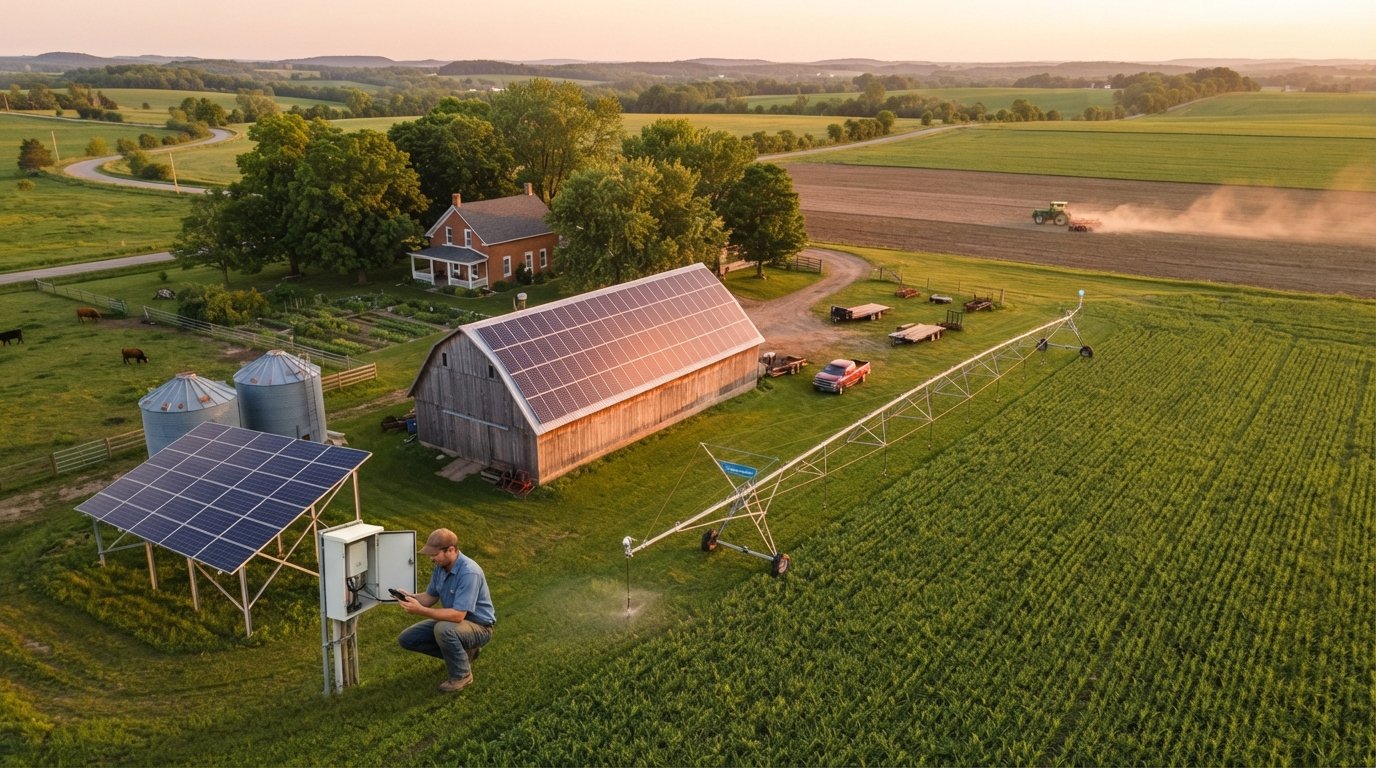
Where you put the panels matters as much as how many you buy. Barn roofs are tempting because they are already there, but not every agricultural roof is built for the added dead load and wind uplift of a PV array. Metal roofs in good condition often work well with clamp-on mounts that avoid penetrations, while older shingle or rusted metal roofs may need reinforcement or replacement first. Grain bins present a different challenge: their curved surfaces require specialized racking, and the bins themselves may be needed for airflow and maintenance access. In many cases, grain bins are better left alone, and the array goes on a nearby shed or a ground mount.
Open pasture ground mounts are often the most cost-effective and flexible option for small farms. A ground-mounted array can be oriented for optimal sun exposure, elevated to avoid snow accumulation and grazing animals, and sized without worrying about roof structural limits. They also simplify maintenance and inverter placement. The tradeoff is land use: a 10 kW array typically needs roughly 600 to 800 square feet of clear space, and you will want a setback from property lines and drainage paths. For farms with limited open ground, a combination of roof-mounted and ground-mounted panels can balance space constraints with production goals.
Whatever mounting approach you choose, plan for access. Panels need periodic cleaning, especially in dusty agricultural environments, and inverters need ventilation and shade. Leave room for a service walkway and make sure the array is not fenced in a way that blocks maintenance. If you are comparing installation approaches and want independent local providers to assess your barn roof or pasture layout, you can compare quotes from local contractors to get a realistic picture of what your site can support.
Rural Utility Interconnection and Net Metering Limits
Interconnection is where many farm solar projects hit unexpected friction. Rural electric cooperatives and municipal utilities often have different rules than large investor-owned utilities, and some co-ops cap the size of customer-sited generation at a percentage of annual consumption or impose standby charges. Net metering policies also vary widely: some utilities offer full retail credit for exported kilowatt-hours, while others use avoided-cost rates that are significantly lower. Before you commit to a system size, request your utility's interconnection manual and net metering tariff in writing. Ask specifically about capacity limits, application timelines, insurance requirements, and whether exported generation is compensated at retail or wholesale rates.
For farms with multiple meters, such as a house, a barn, and an irrigation service, you may be able to aggregate loads or install separate systems behind each meter. Some utilities allow virtual net metering or meter aggregation for agricultural accounts, but these programs are not universal. If your utility offers only limited export compensation, sizing the array to your daytime load rather than your total annual consumption often produces a better financial outcome. In that scenario, the solar PV system for small farms and agricultural operations functions primarily as a load-reduction tool rather than a grid-export revenue generator. That distinction should shape your design conversations with installers.
Interconnection timelines can also affect project scheduling. Some rural utilities take several months to review applications, especially for three-phase service or systems above 25 kW. Build that lead time into your planning, particularly if you want the system operational before irrigation season. A reputable installer will handle the paperwork, but you should still review the application and understand the approval milestones. Keep copies of every submission and follow up proactively, because a stalled interconnection can delay your entire project.
Incentives and Rural Energy Programs That Improve Payback
Farm solar economics depend heavily on incentives, and agricultural operations have access to programs that residential homeowners do not. The most significant is the USDA Rural Energy for America Program, commonly known as REAP. REAP provides grants and guaranteed loans for renewable energy systems and energy efficiency improvements in rural areas. Grant levels and funding rounds change, so verify current details with your state's USDA Rural Development office. In addition to REAP, the federal investment tax credit applies to solar systems on business and agricultural properties, and bonus depreciation or accelerated depreciation may improve the after-tax return for operations that qualify.
State and local programs can add meaningful value. Some states offer property tax exemptions for agricultural solar, sales tax exemptions on equipment, or state-level grant programs. Utility-run efficiency programs may also provide incentives for variable frequency drives on irrigation pumps, which pair well with solar because they reduce overall load. The key is to stack incentives correctly and understand which ones are taxable or which reduce your basis for other credits. Work with a tax professional who understands agricultural operations, and ask your installer for a detailed incentive summary that separates confirmed programs from speculative ones.
Here is a practical checklist for evaluating incentive opportunities:
- Confirm REAP eligibility and application deadlines with your state USDA Rural Development office.
- Verify whether your farm qualifies for the federal investment tax credit and any bonus depreciation.
- Check state property tax and sales tax treatment for agricultural solar equipment.
- Ask your utility about efficiency rebates for irrigation or refrigeration upgrades that complement solar.
- Document all incentive applications and approvals for your tax records.
After you have a clear picture of incentives, build a simple payback model that includes installed cost, incentives, annual energy savings, and maintenance. A well-designed system for a small farm often has a payback period in the range of five to nine years, but that number varies with utility rates, incentive availability, and how much of your generation you consume on site. Be conservative with assumptions about future utility rate increases, and do not count on incentive programs that have not been confirmed in writing.
Design and Maintenance Considerations for Agricultural Solar
Agricultural environments are hard on equipment. Dust, pollen, bird droppings, and crop residue can reduce production if panels are not cleaned regularly. In some regions, snow accumulation and hail risk require more robust racking and module selection. Choose panels with strong wind and hail ratings, and consider microinverters or DC optimizers if partial shading from trees, silos, or barns is unavoidable. Inverter placement should be in a shaded, ventilated location away from livestock and moisture. Wiring should be protected from rodents and UV exposure, and ground-mount arrays should be elevated enough to clear snow and avoid equipment damage from mowers or tractors.
Maintenance is generally modest but not zero. Plan for periodic visual inspections, annual cleaning in dusty areas, and inverter monitoring. Many systems come with monitoring platforms that alert you to underperformance, which is especially valuable on a farm where you cannot check the array every day. Keep a simple maintenance log and schedule professional inspections every few years, particularly after severe weather. If your operation includes livestock, fence the array or use elevated racking to prevent damage from grazing animals.
Finally, think about future expansion. Farms often add loads over time, whether that is a new cooler, a larger irrigation pump, or an electric vehicle for farm use. Design your conduit, combiner boxes, and interconnection capacity with some headroom so you can add panels later without replacing major equipment. A solar PV system for small farms and agricultural operations is a long-term asset, and a little foresight during design can save significant cost down the road.
Financing and Comparing Quotes for Farm Solar
Most farms pay for solar through a combination of cash, agricultural loans, and incentive proceeds. Equipment financing and operating loans from agricultural lenders can spread the cost over time, and some lenders offer specialized renewable energy loan products. Leases and power purchase agreements are less common in agricultural settings than residential, but they do exist for larger projects. Whatever route you choose, compare the total cost of ownership rather than just the upfront price. Ask each installer for a detailed breakdown of equipment, labor, permitting, interconnection fees, and expected production. Be wary of production estimates that seem optimistic relative to your load profile and location.
Getting multiple quotes is essential. Independent local providers may differ significantly in design approach, equipment selection, and pricing. When you request quotes, provide your interval data, a site map, and your goals (for example, offsetting irrigation versus powering a barn). Ask each provider to explain their assumptions about shading, soiling, and degradation. A good quote will include a production guarantee or performance estimate with clear caveats. If you want to compare local installation professionals and plan ahead, NewSolarQuotes offers a free matching service that connects you with independent third-party providers in its network, with no obligation. You can call (833)-212-3715 for expert guidance on how to prepare for those conversations.
Before signing, confirm who handles permits, utility interconnection, and inspections. Clarify the warranty terms for panels, inverters, and workmanship, and ask how service calls are handled. A solar PV system for small farms and agricultural operations is a significant investment, and the quality of the installation matters as much as the equipment. Take your time, ask questions, and choose a provider who understands agricultural loads and rural interconnection rules.
Farm solar works best when it is designed around your actual operations, not a generic template. Start with your load data, understand your utility's rules, stack the incentives you can confirm, and choose a mounting strategy that fits your land and buildings. With careful planning, a solar PV system for small farms and agricultural operations can deliver decades of stable, predictable energy for your farm.
Learn more about Solar Panel Installation and Repair for guides, costs, and what to expect.
Compare Solar Panel Installation and Repair Pros Near You
Enter your ZIP code to compare independent local professionals and request free quotes.