Solar Easement and Shade Analysis: Protect Production
Solar easement and shade analysis protect your panel output for decades. Call 8332123715 to compare local solar quotes today.

By Amelia Griffin
Learn more about Solar Panel Installation and Repair for guides, costs, and what to expect.
Compare Solar Panel Installation and Repair Pros Near You

Enter your ZIP code to compare top-rated local professionals and request free quotes.
Your solar panels can lose 10 to 25 percent of their output from a single shade source you did not anticipate. That is not a manufacturing defect or an inverter problem. It is a property rights and site planning problem, and it costs you money every sunny hour of every day. Most homeowners focus on panel efficiency and inverter quality, then sign an installation contract without ever confirming who controls the trees, buildings, or future construction that could block their array. A solar easement and shade analysis, done correctly before you sign, is how you protect production for the next 25 years.
What a Solar Easement Actually Does
A solar easement is a recorded legal agreement that protects your access to sunlight across someone else's property. It is not a contract between you and your neighbor that lives in a drawer. It is filed with your county recorder, it runs with the land, and it binds future owners of the burdened property. If your neighbor sells their house in eight years, the new owner is still subject to the easement terms you negotiated.
The easement typically defines a solar access plane, an imaginary three-dimensional boundary that the neighboring property cannot build into or grow vegetation into. It also specifies the hours of guaranteed sunlight, usually something like 9:00 AM to 3:00 PM year-round, and it sets remedies if the easement is violated. Some states have specific statutes governing solar easements, while others rely on common law and private negotiation. This matters because the enforceability of your easement depends heavily on where you live and how carefully the document was drafted.
What a solar easement is not: it is not a guarantee that your utility will credit you for every kilowatt-hour you produce, it is not insurance against equipment failure, and it is not a substitute for a proper shade analysis. It is one layer of protection, and it only works when paired with accurate data about where shade actually falls on your roof throughout the year.
Why Shade Analysis Comes First
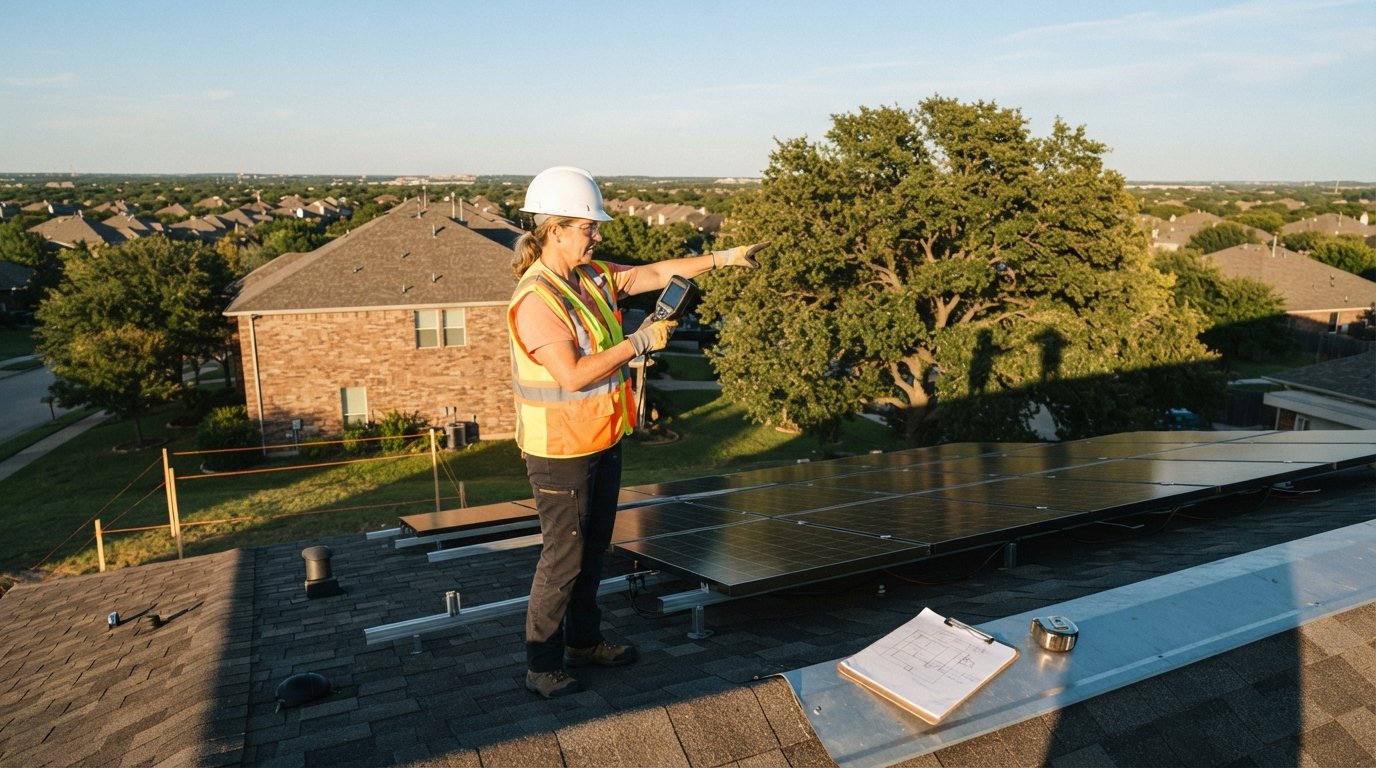
You cannot negotiate a meaningful easement without a shade analysis, because you need to know exactly which obstructions matter and when. A shade analysis uses site measurements, solar path data, and modeling software to map how shadows move across your array over a full year. The output is usually a shade report showing production loss percentages by month and by panel string.
Modern shade analysis tools combine GPS coordinates, roof pitch measurements, and a fisheye photograph or LiDAR scan of the skyline from the array location. The software overlays the sun's path for your latitude and calculates when each obstruction will block direct irradiance. A tree that shades your roof at 7:00 AM in June may be irrelevant, while a chimney that shades one panel at 1:00 PM in December could cut your winter production by 20 percent.
This is why generic estimates fail. An installer who eyeballs your roof and says "looks pretty sunny" is not giving you a shade analysis. You want a report with hourly shading fractions, annual production impact in kilowatt-hours, and a clear identification of which obstructions are worth addressing through trimming, removal, or legal agreement.
How to Conduct a Proper Shade Analysis
A thorough shade analysis follows a defined process. Skipping steps here means you negotiate easements for the wrong obstructions or miss the ones that actually matter. The sequence below reflects what a qualified solar designer or third-party analyst should deliver.
- Site survey and obstruction inventory: Measure roof planes, note pitch and azimuth, and catalog every tree, building, chimney, vent, and future growth risk within 200 feet.
- Solar path and irradiance modeling: Use your latitude and typical meteorological year data to plot the sun's position hourly across all 8,760 hours of the year.
- Shading simulation: Run the obstruction inventory against the solar path to produce per-panel shading percentages and string-level production losses.
- Financial translation: Convert lost production into dollars using your utility rate, net metering policy, and expected escalation over the system life.
- Mitigation ranking: Identify which obstructions justify trimming, removal, panel layout changes, or easement negotiation based on cost per recovered kilowatt-hour.
The financial translation step is where most analyses stop short. A 12 percent annual production loss on a 10 kW system in a market with $0.14 per kWh rates represents roughly $200 per year in lost value, or $5,000 over 25 years before accounting for rate increases. That number tells you how much it is worth spending on legal fees, tree work, or a different array layout.
If you want to understand how production losses interact with storage decisions, our analysis of solar battery storage cost analysis explains how to size backup capacity when your array is already underperforming.
Negotiating and Recording the Easement
Once you know which obstructions matter, you can approach the affected property owner with specific requests rather than vague concerns. A productive negotiation starts with the shade report in hand. You are not asking your neighbor to never plant a tree; you are asking them to agree that a specific zone will remain clear of obstructions above a defined height during defined hours.
Key terms to negotiate include the duration of the easement (perpetual is standard for solar), the geographic scope, the vertical and horizontal boundaries of the protected solar access plane, permitted exceptions for existing vegetation, maintenance obligations, and remedies for violation. Some easements include a right of entry for trimming, while others simply prohibit new obstructions and leave enforcement to civil action.
Compensation is negotiable. Some neighbors will grant an easement for goodwill, especially if you offer to pay for professional trimming of existing trees. Others may want a one-time payment or an annual fee. In dense suburban markets, easement payments in the low thousands of dollars are common, and they are almost always cheaper than the production loss they prevent.
Recording the easement is non-negotiable. An unrecorded agreement may bind the original parties but will not automatically bind future owners in most jurisdictions. Work with a real estate attorney who understands solar access law in your state, and budget $500 to $2,000 for drafting and recording depending on complexity.
Shade Mitigation When Easements Are Not Possible
Sometimes the obstruction is on your own property, or the neighbor refuses to negotiate, or local tree ordinances protect the offending vegetation. In those cases, you protect production through design and technology rather than law. The goal is to minimize the impact of unavoidable shade and maximize the output of unshaded portions of the array.
Module-level power electronics, either DC optimizers or microinverters, allow each panel to operate independently. Without them, shade on one panel can drag down an entire string. With them, you lose only the shaded panel's contribution. This does not eliminate shade losses, but it can cut them by half or more in partial-shading scenarios. The added cost is typically $0.10 to $0.30 per watt, which is often justified when shade is unavoidable.
Strategic panel layout also matters. Moving panels away from the shade source, even by a few feet, can significantly reduce annual losses. A good designer will model multiple layouts and show you the production difference. Do not accept a single layout without seeing alternatives.
Finally, consider whether the shade source will grow. A 15-foot tree today may be 30 feet in ten years. Your shade analysis should include a growth projection, and your easement, if you get one, should address future growth explicitly.
Protecting Production Over the Full System Life
Solar easements and shade analyses are not one-time tasks. They are the foundation of a production protection strategy that should be revisited periodically. Trees grow, neighborhoods change, and new construction can appear without warning. A production monitoring system that tracks actual output against modeled output will alert you when something has changed.
If you notice a gradual decline that does not match weather patterns, investigate. It could be soiling, equipment degradation, or a new obstruction. Catching a shade problem early gives you more options: you can negotiate before the obstruction becomes entrenched, or you can adjust your expectations and plan for storage or grid purchasing to cover the shortfall.
For homeowners who want independent guidance on system design, financing, and installer selection, FreeSolarPowerQuotes provides educational resources and connects you with vetted providers at no cost. The key is to bring your shade analysis and easement questions to every conversation, because the cheapest system that ignores shade is not the cheapest system over 25 years.
Common Mistakes That Cost You Production
The most expensive mistake is skipping the shade analysis entirely because the roof looks sunny from the ground. Ground-level perspectives miss obstructions that appear at different sun angles. The second most expensive mistake is accepting an installer's verbal assurance that shade "won't be a problem" without a written report.
Another common error is negotiating an easement without legal review. A poorly drafted easement may be unenforceable, may not bind future owners, or may fail to define the solar access plane with enough precision to prevent disputes. The cost of an attorney is trivial compared to the cost of litigation or lost production.
Finally, many homeowners fail to account for their own future needs. If you plan to add panels, an electric vehicle, or a battery system later, your shade analysis and easement should cover the expanded array footprint, not just the initial installation.
Protecting solar production is a combination of good data, clear legal rights, and smart design. Start with a professional shade analysis, negotiate easements where they matter, record them properly, and monitor production over time. Your system will deliver what you paid for, and your investment will hold its value for decades.